Hip Hop Heresies by Shanté Paradigm Smalls
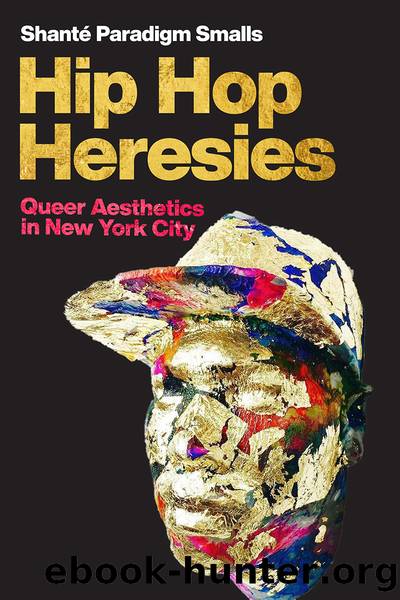
Author:Shanté Paradigm Smalls
Language: eng
Format: epub
Publisher: NYU Press
The Problem with Normal: Heteronormativity in Hip Hop Performance and Culture
Heteronormativity blocks the material experiences of Black people. Yet many Black people strive for a heteronormative persona even if itâs not âreality.â53 In much of hip hop culture and performance there is an emphasis on maintaining the rigidity of categories, even if those categories fail to adequately speak to and manifest the material and psychic experiences of Black folks. Grae, through her performances, resists the bondage of heteronormativity. In this way, she allows one to âsee the gendered and eroticized elements of racial formations as offering rupturalâi.e., criticalâpossibilities.â54 She shows Black heteronormativity as a performance and by exposing it as a showâa performative postureâallows the listener to engage with the critical possibilities of alternative or âqueeredâ performances, and thus formations, to heteronormativity. These alternative performances to heteronormativity produce an anxiety at the site of their critique precisely because they expose the supposed naturalness of heteronormative expectations (rigid masculinity, acquiescent femininity, racial hegemony, nationalism, compulsory heterosexuality, etc.) as a learned set of behaviors. This is not to say Grae calls her work queer, even as her performances disrupt the audienceâs aural or visual expectations. Nonetheless, her performances and affect expose the holes in the seemingly natural, impenetrable world of Black heteronormative heterosexual relations. Graeâs performances are âqueerâ in relation to heteronormativity and its effects; she offers an alternative, an invitation to question the ways that race, sexuality, desire, and violence play out through prescribed gender roles and circumscribed gender expression.
Jean Grae is a female hip hop performer in a male-dominated music industry and genre.55 Her status as woman automatically marks her as a potentially lesser body in the masculine performance space of hip hop culture.56 Grae, in line with the position of females in rap history, is in dialogue with the greater social arena, but also with her rap female and male counterparts. As Tricia Rose notes, âDialogism ⦠accommodates the tension between sympathetic racial bonds among black men and women as well as black womenâs frustration regarding sexual oppression at the hands of black men.â57 Grae goes beyond the dialogical dynamic of Black heterosexual relationships. She slides between the positions of male and female, as I have demonstrated with âThe Illest,â often creating a hybrid third. This hybridity disrupts the linearity of heteronormative dialogue and dialectic, introducing a new figureâan enigmatic voice in hip hop that does not equate sex with gender and does not limit deftness to males or masculinity. Jean Graeâs place in the hip hop landscape occupies the liminal space of impossibility, insofar as she operates against what Peggy Phelan identifies as âmimetic correspondence.â58 Graeâs purposeful impossibility (the hybrid third), irresolvability, and unattainability undo the ârequire[ment] that the writer/speaker employs pronouns, invents characters, records conversations, examines the words and images of others, so that the [listener] can secure a coherent belief in self-authority, assurance, presence.â59 Grae engages in the possibilities of a critical relationship to Black female sexuality that is neither reactionary nor acquiescent, nor particularly concerned with any overt agenda.
Download
This site does not store any files on its server. We only index and link to content provided by other sites. Please contact the content providers to delete copyright contents if any and email us, we'll remove relevant links or contents immediately.
| Biographies | Business |
| History & Criticism | Instruments |
| Musical Genres | Recording & Sound |
| Reference | Songbooks |
| Theory, Composition & Performance |
The Goal (Off-Campus #4) by Elle Kennedy(13645)
Kathy Andrews Collection by Kathy Andrews(11798)
Diary of a Player by Brad Paisley(7542)
Assassin’s Fate by Robin Hobb(6191)
What Does This Button Do? by Bruce Dickinson(6190)
Big Little Lies by Liane Moriarty(5778)
Altered Sensations by David Pantalony(5091)
Pale Blue Dot by Carl Sagan(4990)
Sticky Fingers by Joe Hagan(4179)
The Death of the Heart by Elizabeth Bowen(3599)
The Heroin Diaries by Nikki Sixx(3537)
Beneath These Shadows by Meghan March(3295)
Confessions of a Video Vixen by Karrine Steffans(3292)
How Music Works by David Byrne(3252)
The Help by Kathryn Stockett(3131)
Jam by Jam (epub)(3070)
Harry Potter 4 - Harry Potter and The Goblet of Fire by J.K.Rowling(3050)
Computational Linguistics and Intelligent Text Processing: 20th International Conference, CICLing 2019 La Rochelle, France, April 7â13, 2019 Revised Selected Papers, Part I by Alexander Gelbukh(2976)
Strange Fascination: David Bowie: The Definitive Story by David Buckley(2850)
